
Ask rediffGURU and PF expert Nitin Narkhede your mutual fund and personal finance-related questions.

'They are ideal for short-term financial goals like children's education or a down payment for a house.' 'They are also useful for transitional savings, such as during job switches or while starting a business.'

Equity benchmarks face a key test as investors weigh consumption revival hopes against tariff pressures and weak earnings. Amidst this, HSBC has outlined tailwinds and risks that could cap gains.

Domestic institutional investors (DIIs) poured in Rs 94,829 crore of fresh money into Indian equities in August, the second-highest monthly inflow after record Rs 1.07 trillion influx in October 2024.

Call centres, once the engine room of India's BPO exports, are evolving too. Depending on the complexity, 30 to 50 per cent of voice and chat volumes are now handled by conversational AI.

Markets regulator Sebi has proposed introducing a single window access for low risk foreign investors seeking to participate in the Indian securities market, a move aimed at simplifying compliance and enhancing the country's attractiveness as an investment destination.

The Indian economy could remain less affected by global trade wars than other countries because the two engines of domestic growth - consumption and investment - are likely to face a limited impact from such headwinds, according to an article on the 'State of the Economy' in the Reserve Bank of India's (RBI's) bulletin, released on Tuesday.

Equity markets this week will turn their focus on the RBI's interest rate decision, Q1 earnings from several blue-chip firms and tariff-related news for further cues, analysts said. Moreover, trading activity of foreign investors and trends in global equity markets will also drive investors' sentiment.

Ask rediffGURU and PF expert Milind Vadjikar your insurance, stocks, mutual fund and personal finance-related questions.

More than 30 technology startups, collectively valued at $100 billion, are poised to go public by 2027, signalling a potential rebound in India's stock market activity, according to a report by investment bank The Rainmaker Group. Walmart-owned Flipkart, financial technology (fintech) leader PhonePe, SoftBank-backed Lenskart, Razorpay, Zetwerk, and Meesho are among the top companies preparing to go public in India.

India's BFSI sector is set for robust growth, with hiring projected to rise 8.7 per cent in 2025-26 and touch 10 per cent by 2030, creating nearly 2.5 lakh permanent jobs, a report said on Thursday. This growth in the Banking, Financial Services, and Insurance (BFSI) sector is being driven by rising demand in tier II and III cities, marking a clear shift from metro-centric recruitment.
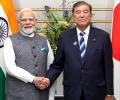
Prime Minister Shigeru Ishiba's sudden resignation after only a year in office has thrown Japan into political turmoil, raising doubts about how the country will handle economic and regional challenges, observes Dr Rajaram Panda.

Apex exporters body FIEO on Tuesday expressed serious concerns over high US tariffs on Indian goods and said that textiles and apparel manufacturers in Tirupur, Noida, and Surat have halted production amid worsening cost competitiveness due to these steep duties. The US duties on Indian goods will increase to 50 per cent from August 27.
Kotak Mahindra Bank's net interest margin is likely to swell after the Reserve Bank of India (RBI) lifted its restrictions on the private lender that barred it from issuing fresh credit cards and onboarding new customers through digital mode, brokerages said on Thursday. The bank's net interest margin (NIM) has seen a decline of over 35 basis points (bps) since the restrictions were imposed by the regulator in April 2024.

Clarity on Tata Sons' position on listing, as of 2025, would help define the future of the group better, irrespective of the RBI stand. As of now, the ball is in the RBI's court, and everyone is watching the space, points out Nivedita Mookerji.

From the Sensex pack, NTPC, Tech Mahindra, Zomato, Axis Bank, Bajaj Finance, Infosys, Maruti, State Bank of India, Kotak Mahindra Bank, Reliance Industries, Hindustan Unilever, and HDFC Bank were the losers. IndusInd Bank, HCL Tech, Titan, Mahindra & Mahindra and Power Grid were the gainers.

OYO founder Ritesh Agarwal has invited name suggestions for its parent firm Oravel Stays, in a strategic move as the global travel tech platform prepares to launch its IPO and looks to have more premium segment offerings. There is a high possibility that the name chosen through the exercise may end up being the name of the premium hotels app that OYO has been working to launch in the near future, people familiar with the strategy told PTI.

Left to its machinations, the BJP would have loved to cut Nitish down to size, but it can't afford to do so as the JD-U is in alliance with the BJP at the Centre, and cannot form a government on its own in Bihar. For now, both need each other: Nitish for legitimacy, the BJP for numbers, points out Ramesh Menon.

'Market momentum and investor interest are at unprecedented levels, making this the opportune moment.'

Ask rediffGURU Reetika Sharma your insurance mutual fund and personal finance-related questions.

'From tariff tensions and border skirmishes to unrest in West Asia.' 'The worst may be behind us. But any further upmove will now have to come from earnings.'

Non-resident Indians (NRIs) haven't gone big on the Indian stock market story despite the post-pandemic boom. While domestic participation through mutual funds (MFs) and dematerialised accounts has soared, NRI participation figures show limited signs of a similar rise.

'As we navigate uncertain waters, a conservative approach to largecap investing could provide a strategic advantage.'

The growth was primarily driven by domestic investments, which accounted for 60 per cent of the total inflows during the first quarter of the financial year.

JPMorgan, Goldman Sachs, Bank of America Merrill Lynch and Morgan Stanley, as well as Britain's Asia-focused Standard Chartered said they would try to support London's financial sector

The bottom lines of several private sector banks have taken a hit following the recent guidelines released by the Reserve Bank of India (RBI) on alternate investment fund (AIF) investments. Last month, the RBI announced that regulated entities, such as banks, non-bank lenders, and home financiers, cannot invest in AIFs that have directly or indirectly invested in companies that have borrowed money from the lenders. In case an entity had already made such an investment, they must liquidate the investment or make 100 per cent provision, RBI had said.

Largecap companies are generally less vulnerable to economic slowdowns than their mid- and smallcap counterparts.

Non-banking financial company (NBFC) Tata Capital is set to launch its much-anticipated $2 billion (Rs 17,200 crore) initial public offering (IPO) in the week beginning September 22, market sources familiar with the matter said on Sunday. The issue is expected to value the company around $11 billion, they added. Tata Capital is likely to make its stock market debut by September 30.

Among Sensex firms, Mahindra & Mahindra, Tata Motors, Trent, Eternal, Asian Paints and Infosys were the major gainers. However, Sun Pharma, ITC, Hindustan Unilever and Titan were among the laggards.

Tata Trusts, which exerts decisive influence over India's most valuable conglomerate through its about 66 per cent stake of Tata Sons, finds itself in the midst of infighting among its trustees over board appointment and governance issues.

Bharti Airtel sees opportunity in raising tariff for data services as it feels that rich are paying less and poor are not required to pay anymore, a senior official of the company said. During the company's earnings call for the first quarter of the current fiscal, Bharti Airtel vice-chairman and MD Gopal Vittal said that the company has written to the government for a relief on adjusted gross revenue and has demanded that it should be given benefit at par with other telecom operator, without naming Vodafone Idea.

Since the first Reit listing in 2019, the sector has grown to a market capitalisation of about $18 billion as of August 2025, and is projected to cross $25 billion by 2030.

'Increasingly, they treat gold as a financial asset in their portfolio rather than just as jewellery.'

Given the stronger rural activity, and potential goods and services tax (GST) impact, investors are bullish on the two-wheeler (2W) segment. In August, dealers in the domestic market picked up 11 per cent more 2Ws year-on-year (Y-o-Y), despite only 2 per cent growth in retail registrations. This indicates inventory stocking ahead of the festival season. Export trends were good. TVS Motor and Royal Enfield may have gained domestic market share.

Re-entry into the list could have far-reaching consequences for Pakistan, including diminished foreign investment, increased borrowing costs, and tighter scrutiny from global financial institutions.

Among Sensex firms, Bharat Electronics rose the most by 4.26 per cent. HCL Tech gained 2.57 per cent, Bajaj Finance by 2.19 per cent, TCS by 1.99 per cent, Tech Mahindra by 1.88 per cent and Infosys by 1.85 per cent. Gains in Axis Bank and State Bank of India also supported the rally. However, Mahindra & Mahindra emerged as the biggest loser, falling by 2.47 per cent. Maruti dropped 1.53 per cent and Tata Motors by nearly 1 per cent due to profit-taking. UltraTech, Eternal and Power Grid were also among the laggards.

Gold prices are expected to maintain their upward momentum though some consolidation could set in ahead of the US Federal Reserve's policy decision on September 17, analysts said. Traders will focus on the trade inflation data to gauge the impact of tariffs, inflation numbers from major economies including UK and Euro zone, along with monetary policy meetings of Bank of England and Bank of Japan which will provide more guidance for bullion prices, they added.

Among Sensex firms, Tata Steel jumped the most by 5.90 per cent. Titan, Mahindra & Mahindra, ITC, Eternal, State Bank of India, and Trent were among the other gainers. However, Infosys, NTPC, Hindustan Unilever, TCS, Adani Ports and Bharti Airtel were among the laggards.
Fair trade regulator CCI on Tuesday cleared Bajaj Group's proposed acquisition of a 26 per cent stake each in its insurance joint ventures, Bajaj Allianz General Insurance and Bajaj Allianz Life Insurance, from its partner Allianz SE for a total of Rs 24,180 crore. "The proposed combination involves acquisition of 26 per cent paid-up equity share capital of Bajaj Allianz Life Insurance Company Ltd (BALIC) and Bajaj Allianz General Insurance Company Ltd (BAGIC) by Bajaj Finserv Ltd (BFS), Bajaj Holdings & Investment Ltd (BHIL) and Jamnalal Sons Pvt Ltd (JSPL) from Allianz SE," the regulator said in a release.

India's economic growth forecast for 2025 has been revised downward to 6.3 per cent, and despite a projected moderation, the country remains one of the fastest-growing large economies, supported by resilient consumption and government spending, the United Nations has said.
 © 2026 Rediff.com - Advertise with us - Disclaimer - Privacy Policy - Sitemap - Feedback - About us - Terms of use - Grievances